
This past semester has been an exciting one for me, as I’ve finally been able to incorporate Kenneth Roberts and his works into my research. I’ll spare you the details, but in short—I explore the role narrative plays in shaping what we know (see earlier posts). As a case in point for my argument, I chose to focus on historical fiction given the supposed contradiction in terms (i.e. historical = truth; fiction = false). In doing so, I explored Kenneth Roberts and his understanding of how fiction can communicate truth about history.
Because I am seeking to publish my paper, I won’t post it on my site. However, I will be sharing soon glimpses into some points I raised about Kenneth Roberts relationship between fiction and history.
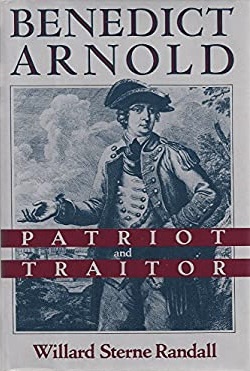
For now, I thought I’d find a neat find. While pursuing the shelves at an Indianapolis Half Price Books, I came across Willard Sterne Randall’s Benedict Arnold: Patriot & Traitor. Two things in particular stood out.
Arnold: Patriot & Traitor
Though not the central point of Rabble in Arms, a significant take away from Roberts 1933 novel was his portrayal of Benedict Arnold. According to Roberts, Arnold was perhaps one of the most competent, patriotic, and daring officers in the Continental Army. On the other hand, other high-ranking officers were petty, backstabbing, conniving, and after their own glory. The picture Roberts paints is quite different from that passed down in school histories and most academic works.
When writing Arundel and, in particular Rabble in Arms, Roberts sought to write Arnold as he saw him in his research. That is, Roberts felt that many scholars and historians allowed Arnold’s treason to color their view of what he did prior to his defecting to the British. Base on his research of original sources, Roberts believed that Arnold’s leadership in the Continental Army was motivated by patriotism and love of country.
Most critics disagreed with Roberts’ portrayal of Arnold, accusing Roberts of revisionist history, motivated by “lost causes…buried in footnotes” ( Bertram, “The Novels of America’s Past (1953), 117; quoted by Janet Harris, The Role of History in Kenneth Roberts’ Novels, 7). However, some, such as Leisy, viewed Roberts as the standard in historical fiction, for he does not attempt to “soothe nationals pride” (Harris, 11).
March to Quebec as Source Material
So thorough was Roberts’ research for his novels, he published some of his research in separate volumes. For instance, his Arnold research is included in March to Quebec. Though Roberts was passed over and disregarded by historians of his day, Coyle suggests that his source books do credit “to the most seasoned historical specialist” (“Kenneth Roberts and the American Historical Novel,” 73). Fast forward to 1990 and Randall’s biography of Arnold, we not only see Roberts’ source material cited as a source, we also see Roberts’ view of Arnold shared by historical scholar.
Though Roberts’ view of historical figures did not always meet with praise (Clinton Roister suggested that Roberts “mad highly selective use of his material” and was “very clever at denigrating historical characters he didn’t like,” quoted by Coyle, 71), his work warrants revisiting given the changes in historiography and epistemology since the 1930s.
As a novelist and historian, Roberts provided lasting “original and important” contributions to American history (Coyle, 74). His pursuit of historical truth and accuracy is revealed in his “uncompromising re-creations of the past” (75), and as a historian, he was a “careful, indefatigable researcher dedicated to the ideals of freedom, individual resourcefulness, and personal independence” (76).


You must be logged in to post a comment.