
Before Kenneth Roberts became a novelist, he was a correspondent for The Saturday Evening Post – a role which put in him in contact with American and world leaders, and placed him in the thick of world-shaping events in Eastern and Western Europe. Roberts’ time at SEP launched his career as a writer and made his name known in households across America.
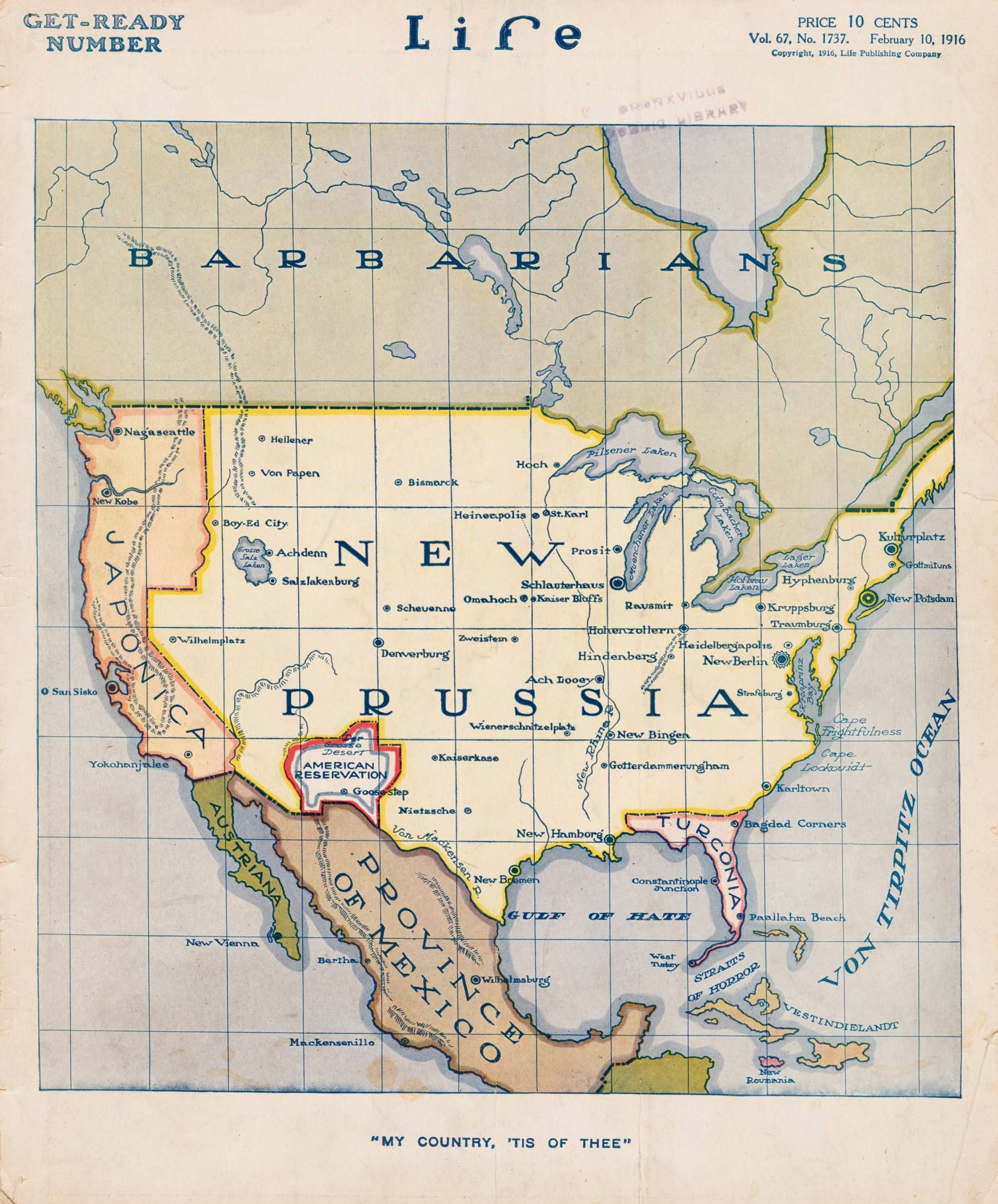
But, before his life-shaping career at SEP, Roberts wrote for Life Magazine over a four-year period: 1916-1919.
Roberts describes how he started contributing to Life in his autobiography, I Wanted to Write. It was in 1916 around the new year when, while working at the Boston Post, that he “made a startling discovery”:
I learned that Life, which at that time was a weekly magazine…, was in the habit of running special issues dealign with certain holidays or trends, and advising a coterie of steady contributors to submit their offerings by a given date (IWW, 58).
Driven by his desire to write, Roberts quickly recognized an opportunity to expand his experience, if only one were to get “a three months’ jump on those who did their writing on rainy afternoons, or when inspired” (58). The ever-industrious Roberts did not wait to be inspired, rather:
I could work on my Sunday page from 6 am to 4 pm, every day and then, for the next fourteen hours, do as I pleased. If I neither ate, read nor sleep, I could work all fourteen hours. If I frittered away two hours on eating and exercising, and slept five hours, I’d still have seven hours left in which to engage in any desired activity (59).
The same day Roberts learned about Life he studies New York and Boston newspapers for ideas to write about, and by midnight of that night, he had five to six pieces written (59-60). He shipped it off to New York that night. Several days later, he received an envelope, but it was the very envelope with his handwriting. Thinking his work was for naught, he opened the envelope, only to find that his work had been accepted by Life – and he had been paid. According to Roberts, the check from Life altered his working schedule (63) – any free time he had was spent working. If a piece was rejected by Life, he would send it to Puck, and if rejected again, he would send it off to Judge.
The year of 1916 was a successful one for Roberts, and it changed the course of his writing career.
Fast-forward over 100 years, and the bulk of Roberts’ existing works (by far) consists of his novels and his early non-fiction books. With patience and luck, one can find copies of SEP that contain Roberts’ contributions, but they are not as easy to find given how easily they can be damaged, lost, or thrown away. Copies of Life from 1916-1919, however, are rather difficult in locating. In fact, I’ve been looking for close to 15 years (at least), and I’ve had no luck whatsoever.
Just last week, though, I have found an online archive of Life magazine that contains the years in which Roberts contributed. Hathi Trust houses scanned copies of Life magazine from the collections of Cornell University, the University of Michigan, and the University of Minnesota. Searching for Roberts’ contributions is not easy, however. Though the scanned copies are PDFs, they are not searchable by keywords (given that the PDFs are just scanned images). So, much like the microfiche machines of yesteryear, you have to look through each file, page by page.
There are some other challenges in locating Roberts’ contributions. First, his name can appear in various forms:
- Kenneth L. Roberts
- Kenneth Lewis Roberts
- KLR
- Lawrence Kane
The last name listed is the pseudonym Roberts used when he served in the Armed Forces during WWI (1918-1919). Roberts wanted to be free to publish what he saw and thought during the war, but doing so would get him in trouble with the Army. So, he arranged with Life‘s editor the pseudonym Lawrence Kane – whose first letters (L. K. ) are a reversal of Roberts’ first and middle initials K. L. (Kenneth Lewis).
Another challenge is that not every piece in Life is attributed to an author. For instance, some of Roberts’ pieces I’ve found do not have his name attached; the only reason I knew they were Roberts’ is the helpful list provided by the Library of Congress (however, the LOC only lists his Life titles from 1919). Nevertheless, with patience, you can discover some of Roberts’ earliest writing.
I’ve found a treasure trove of material to read in the past week, and I’ve more to find. I’ll be posting soon a series of posts related to Roberts’ Life works. Stay tuned.


You must be logged in to post a comment.